Essays and notes from Above The Void.
"Il n'y a même que le merveilleux qui soit beau." (André Breton, Manifeste du surréalisme, 1924)
It took French cinema thirty years to calcify into the Tradition de la Qualité. Generative cinema has managed it in three. This is, I suppose, the one benchmark on which the field's obsession with speed has delivered: we have compressed an entire cycle of academicism, from folk vitality to embalmed prestige, into the lifespan of a houseplant.
Consider what the tendency celebrates. A soft-drink conglomerate remakes its own 1995 Christmas commercial with machines, shot for shot: the same trucks, the same lights, the same route through the same snow, rendered by three studios and praised in the trades for its fidelity to itself. A corporation holding a séance for its own memory and selling the corpse as tradition. A toy chain generates its founder's childhood and calls it wonder: wonder, the one product the store was supposed to stock, outsourced. A fashion-house wizard mashup becomes the founding text of an entire school, and what that school learned from it was not the joke but the method: that any two properties can be interbred, and that the interbreeding counts as making something. And beneath all of it, the changelog film: the short that exists to introduce a model, drama as feature demonstration, cinema with release notes.
In May of this year the tendency produced its monument, and I propose to read it the way Truffaut read Aurenche and Bost: from its own documents. Hell Grind, by Higgsfield, arrived billed as the first feature film created entirely on the company's platform: ninety-five minutes of street thieves and demon hordes, produced in a fourteen-day sprint by a crew of fifteen that included the vendor's own staff, its visuals generated by another company's model wearing the platform's interface, an arrangement the trade press described with accidental candor: the model vendor got its long-form demonstration, the platform got its recruiting reel. Attend to what the phrase by Higgsfield already concedes. The author of record of generative cinema's first feature is a subscription service, and the film behaves like one: its episode pages on the company site offer thirty percent off. A film with a coupon.
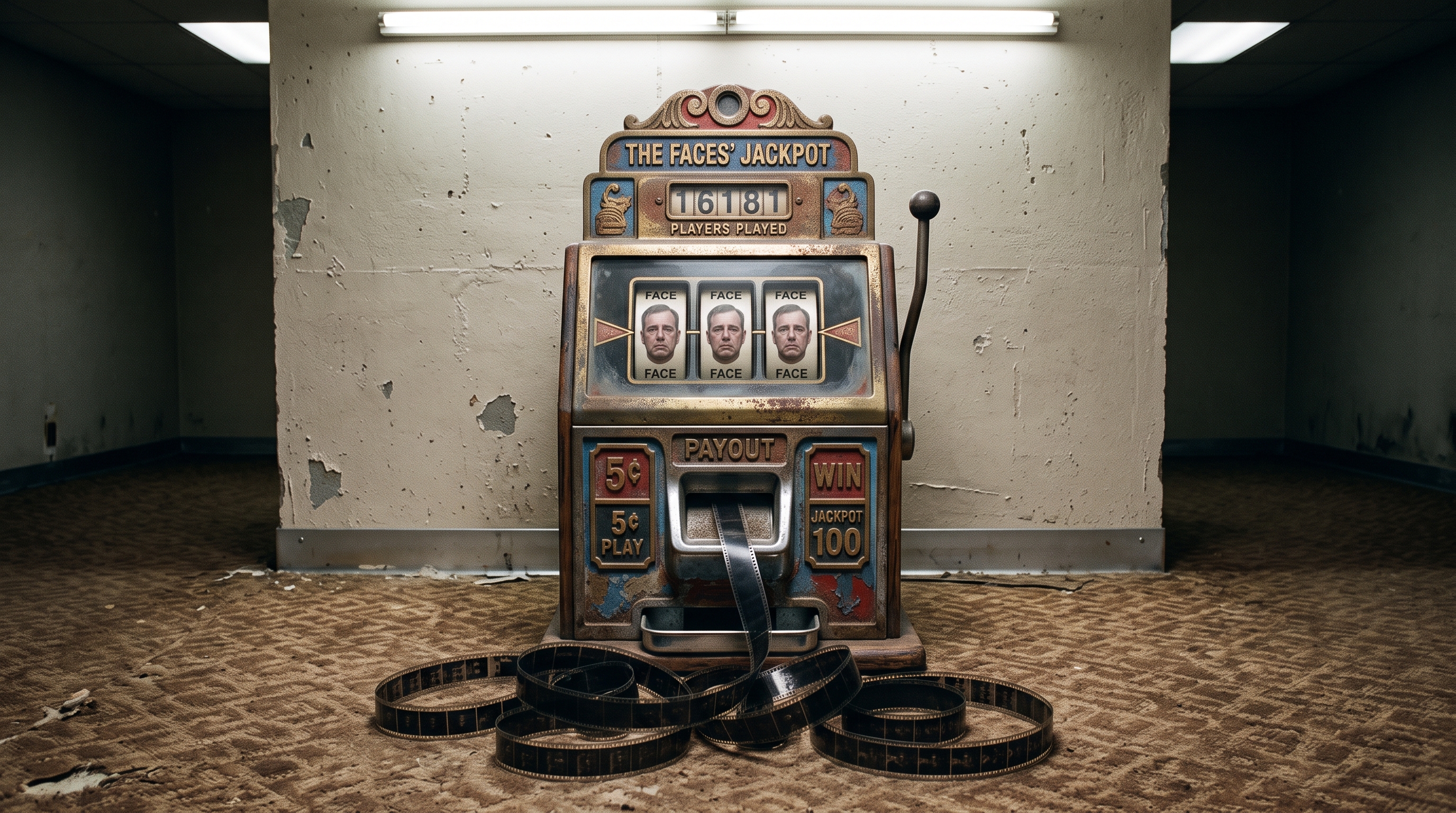
Now the process, in the makers' own published words. To hold the picture together, prompts ran to three thousand words apiece, and the bulk of that wordage was spent reminding the model to obey the laws of physics and to suppress the telltale gloss that would betray the machine. Read that twice. The screenplay of the flagship of generative cinema is an incantation begging the medium not to look like itself: three thousand words per shot, most of them an apology. The chief executive, describing his own production method, said the generation loop had "a feeling of a slot machine". I have not encountered a more honest sentence in this industry, and it was offered as a boast. The company published its arithmetic as a proud disclosure: the first twenty-five minutes required 16,181 generations to yield 253 kept shots, a ratio the friendly coverage reprinted as evidence of curatorial rigor. Of the half-million-dollar budget, four hundred thousand went to compute. Eighty percent of the film was spent pulling the lever, and we are invited to admire the wrist.
Then the consecration, where the tendency's aesthetic method reveals its institutional twin. On the first of May the company announced, in its own words: "We're going to Cannes". The film was then shown twice: a private, invite-only industry preview on the Vieux Port on May 16, and a screening on May 21 at the Olympia, a commercial cinema in the town of Cannes, both within the orbit of the Marché du Film, the trade floor where screening rooms are rented, not awarded. Not the official selection; not any selection. Within days the mechanism completed itself. One entertainment outlet reported an exclusive Cannes Film Festival preview; a filmmaking site announced the trailer of the feature screening at the Cannes Film Festival; the Wall Street Journal opened its story with the film debuting at the festival that Thursday. This time the laundering failed loudly enough that the Festival did something festivals do not do for films they never programmed: it denied the premiere on the record, confirming the film had been shown at a third-party industry event in the city. The company, cornered, defended itself by invoking the Marché du Film as an accredited component of the festival: the trade floor pleading its lanyard. Its founder went on describing the film as having premiered in Cannes. And when a culture desk filed the definitive correction, it ran under the one word this industry has contributed to the vocabulary of error: hallucination. So the pastiche school prompts in the style of Bergman, and its institutions exhibit in the style of Cannes. It is one equivalence process at two scales: when you cannot earn a judgment, rent the adjacency and let the press launder the difference.
Finally, the object itself, as witnessed by the few critics admitted to the invite-only room. The reviewer from a genre outlet sympathetic to spectacle reported that the picture announced its machine origins in every frame, found the experience tedious, and concluded that "it doesn't come close to matching even the weakest movies made by real human beings"; he left the screening less convinced of AI features than when he entered, which makes the flagship the rare advertisement that de-converts. The culture desk that corrected the premiere also reviewed the aesthetic strategy: the production had prompted for natural light to dodge the overlit gloss the public calls slop, and the verdict was that "underlit scenes can also be slop". The trade that headlined the film as premiering in Cannes found the plot incoherent while marveling that the generated children looked unnervingly lifelike, a sentence I will let stand without comment. The platform beneath all of this advertises camera presets and 1,296 virtual lenses; no reviewer located a point of view. And the confession that closes the file came from the chief executive himself, who told the trades the goal was never exactly a quality film but a showcase of the technology, and, asked about genres beyond action, answered: "we're gonna get there probably in the next six, nine months". There is the tendency's complete theory of art, in its own grammar. Drama ships next quarter.
Above this production floats a vocabulary of praise, and the tendency's proudest word, the word it reaches for the way the old Tradition reached for "quality," is consistency. Character consistency. Style consistency. Temporal consistency. Entire conference talks, entire funding rounds, entire festival categories, organized around the dream of a face that does not melt. An art form's whole ambition, compressed into the hope that a face will not melt.
I want to say this as precisely as I can: we have built a cinema whose masterpieces are certificates of obedience. The jury copy gives it away. The highest praise this tendency knows how to give a film is that it is indistinguishable from live action. Imagine praising a novel because it is indistinguishable from a police report.
I will call this school what it calls itself. The Cinema of Consistency.
In January 1954, in the thirty-first issue of Cahiers du Cinéma, a twenty-one-year-old with no films and a juvenile record published an attack on the most decorated screenwriters in France. François Truffaut's method was not opinion; it was forensics. Jean Aurenche and Pierre Bost, the licensed adapters of the Tradition de la Qualité, worked by a process Truffaut exposed from their own scripts: when they judged a scene in a novel unfilmable, they invented an equivalence, a substitute scene. And the equivalences, he showed, always leaked the same fluids: the same cynicism, the same profanation, regardless of the author being adapted, which meant the adapters held both literature and cinema in contempt. In their system the director was reduced to the gentleman who adds the pictures. Against them Truffaut named the men who write with the camera, and he closed by refusing the handshake: he did not believe in the peaceful coexistence of the Tradition of Quality and a cinema of auteurs.
Our screenwriters are prompt-writers, and the equivalence process has survived the translation intact. It has a new name. It is called in the style of.
When the Cinema of Consistency cannot render a vision, usually because a vision has not occurred, it substitutes a reference to someone who once had one. Read the celebrated prompts of the tendency; they are published proudly, which spares us the archival work Truffaut had to do. The archetype runs: 35mm, anamorphic, in the style of three dead cinematographers, moody, cinematic, 8k, masterpiece. That is not a sentence. It is a bibliography. Six proper names and zero decisions. And at feature scale the bibliography becomes a filibuster: the flagship has told us its prompts averaged three thousand words, most of them pleading with physics. Run the test on any of them: strike the names and see what remains. Weather. "Cinematic" is not an idea; it is a settings preset, shallow focus and teal shadows. "Masterpiece" is typed into the text box the way a coin is dropped into a fountain.
The old Tradition made the director the gentleman who adds the pictures. The new one has automated him. The model adds the pictures now, and the prompt-writer has been promoted to the gentleman who adds the names. And everyone at the table calls each other auteur.
Like its ancestor, the Cinema of Consistency runs on contempt, and the contempt has three addresses.
Contempt for history. The tendency does not study the canon; it strip-mines it. A century of cinema reduced to a style library, dead masters reduced to seasoning. Tarkovsky is not a token. The tell is that the invocations never engage the thing invoked: nobody prompting "in the style of Bergman" is wrestling with Bergman; they are borrowing the fame of the name because fame is legible to an audience that has also not watched the films. They do not love the films. They love that the films are famous enough to function as ingredients.
Contempt for the audience. The tendency's films are engineered for a single emotion, the wow reflex, and the intended thought is did a machine make this, a thought that expires the moment it is answered. These are screenshots with runtimes. The audience is modeled as an engagement surface, a scroll with a pulse. The flagship made the theory explicit: it cast its own audience, filming a veteran studio director watching an excerpt and posting his stunned face as the advertisement. The reaction shot replaced the review. No film of this school risks being disliked, because dislike requires that something was attempted.
Contempt for the medium. This is the deepest one, and the one I take personally. We were handed the only image-making instrument in history that dreams by default, a machine whose native condition is the marvellous, whose untrained instinct is to melt, multiply, and be wrong in ways no camera has ever been able to be wrong. The early folk period proved it. The spaghetti video, the melting faces, the extra fingers: involuntary surrealism, the medium speaking in its own tongue, and genuinely alive. The Cinema of Consistency looked at this dreaming thing and issued its first commandment: hallucinate normalcy. We lobotomized the only dreamer we ever built until it could impersonate coverage, we called the lobotomy progress, and we called the scar tissue consistency.
Let me be exact, because I use these tools daily and this essay is not a Luddite's. Consistency as carpentry is fine; a narrative needs a face to hold. Consistency as telos is the disease. I am not against a face that holds. I am against the held face as the entire ambition of an art form.
Photography already ran this experiment and published the results. It spent its first decades in soft focus, staging allegories, apologizing for not being painting, and earned nothing but the condescension it was courting. Legitimacy arrived the day the medium stopped apologizing: sharp focus, straight prints, the things only a lens could do. Photorealism as the highest virtue of generative cinema is our pictorialism. It is the medium apologizing for existing.
Here I break with the tendency's defenders as sharply as with the tendency, because the standard defense of this medium is a shrug, and the shrug is unearned.
The striking artists are not wrong. The VFX artist watching her week become a minute is not confused about what the tool enables; she understands it with total clarity. The training corpora ate uncompensated labor, and some artists now compete against their own ghosts. The Cinema of Consistency answers this grievance with denial, a shrug, or a subpoena. A cinema that intends to be an art needs a doctrine instead, and the doctrine is this: provenance is part of the work. A generated film has a diet, and the diet is in the film, the way a building's materials are in the building.
Practice, not purity. For a film about Daniil Kharms I translated the Russian sources myself, four volumes of the collected works open on the desk, because a living translator's labor was not mine to strip-mine. The model's diet I did not choose; the film's diet I did, and that is the layer where a filmmaker's ethics actually operate. The pastiche school launders the living. The alternative is not abstinence; it is appetite with a conscience: feed on the dead who cannot be robbed, on the licensed, on the commons, on yourself. The public domain is not a loophole. It is an inheritance, and inheritances come with duties.
Now the question the tendency cannot answer and the skeptics believe is unanswerable: where is the author in a generative pipeline?
The genealogy has been sitting in plain sight for a hundred years, unclaimed because the tendency does not read. 1924. Breton publishes the first Manifesto and defines surrealism as psychic automatism: a technology for generating images beyond conscious intention. The Bureau of Surrealist Research opens on the rue de Grenelle, taking dictation from dreams, minutes kept: the first prompt lab. A year later, around a table on the rue du Château, the cadavre exquis: multi-agent generation, 1925, wine included. The surrealists built our machine a century early. It was slower, and it drank.
And they learned, immediately, the lesson the Cinema of Consistency refuses to learn: automatism is not the art. Automatism is ore. Breton spent the rest of his life excommunicating fakers who mistook the faucet for the fountain. The ones who made cinema out of automatism authored with the razor. Un Chien Andalou is dream-sourced and cut-authored: a cloud slices the moon, therefore a blade slices the eye. The images came from the night; the meaning lives nowhere but the cut. Maya Deren, two decades later: the dream brought under control, structure imposed on trance.
So the doctrine. The model is not a camera. The model is an unconscious: a rented one, an industrial one, average by design, because it is the compressed dreaming of everyone who ever posted an image. Reviewers of the flagship arrived at this theory empirically, no manifesto required: its heroine, one wrote, was less a character than "an amalgamation of attractive features that an algorithm averaged together". Astruc promised us the caméra-stylo. We received something stranger: a stylo that writes back. An unconscious is precisely the faculty an author was never before permitted to outsource, and now it is available by subscription. This does not abolish authorship. It relocates it, to the one place it has always actually lived: the author of a generated film is the one who can answer for the cut. Generation is abundant and therefore worthless. Sequence is scarce and therefore everything. In my own practice the machine is consulted at the level of the shot and holds no opinions above its station; acts, scenes, and beats are decided by a person who can be interrogated about them.
And do not mistake this for a sermon against overproduction. Automatism has always overproduced; the surrealists threw away more than they kept, and so do I. Sixteen thousand generations is not the scandal. The scandal is what did the selecting. A razor selects for meaning and can say why. A jackpot selects for whatever passes, and the flagship's pass condition, by its own published account, was obeying physics and looking real enough. A ratio of sixty-four to one where the sixty-three die for the sake of meaning is a kill rate; a ratio where the winner is whichever pull most resembled a movie is a casino with a render farm attached, and the house, as always, took eighty percent.
Because a doctrine that cannot be tested is a mood, here are four tests any critic may run on any generated film, none requiring access to anyone's prompts:
These tests will fail most of what this medium currently celebrates, including, some days, my own contact sheets. Good. An art form exists on the day its films can fail. If nothing can be bad, nothing is good, and until now nothing in generative cinema has been permitted to be bad: only impressive, uncanny, or concerning, the vocabulary of a technology review.
I will enter one exhibit, not as a masterpiece but as an existence proof. The Patient: twenty-five minutes, made in ten days, produced as a cadavre exquis played with the machine, écriture automatique in the text box and a razor in the timeline, structure on paper before a single frame was generated. It is currently doing what films, as opposed to demos, do: being judged by strangers. Its selections are at AI festivals, and after the previous pages I owe them their exact names, Burano, the AI Film Awards, a MetaMorph shortlist in London, because the precision is the doctrine: a laurel names the room where you were judged, not the town the room was in. I cite it for one reason only: the method yields films. The automatism is real, the authorship is real, and neither required the other's abolition. The surrealists would have recognized the game immediately. They invented it.
I am told the two cinemas can share the medium: the Consistency school taking the brand budgets, the authors taking the margins, everyone following each other on the same platforms. Truffaut heard the same offer, and I will give the same answer. I do not believe in the peaceful coexistence of the Cinema of Consistency and a cinema of authors.
They are not two markets. They are two theories of what this machine is for, and they cannot both be right. Every frame of pastiche teaches the audience that the medium is a mirror, a device for reflecting things they already recognize. Every unfakeable film teaches them it is a door. The tendency's work trains the public to ask how real; ours trains them to ask why this. One of these questions has a future in the history of art. The other has a future in advertising, which is where the Tradition de la Qualité also ended up, prestige and all.
So a prediction, falsifiable like the rest. The canon of this medium, the films that will hang in the main competition rather than the demo reel, will be the unfakeable ones: films that could not have been shot, in which the medium is the meaning and not the alibi. The rest is content, and content is the name culture gives to things it has already forgotten.
The essay's job is the grammar. The film's job is the proof. Mine is next, and it will not be polite.